
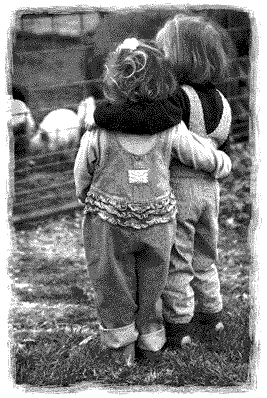
 “A friend is a person with whom I may be sincere. Before him I may think aloud.” Ralph Waldo Emerson
 Self-disclosure: is a special type of conversation in which we share intimate information and feelings with another person (Sears, Peplau & Taylor, 1991). It’s the process of deliberately revealing information about oneself that is significant and that would not normally be known by others (Adler & Rodman, 2006). It involves personal information that is verbally communicated to another person (Chelune, 1979; Cozby 1973, as cited in John & Valerian, 1987).
This personal information may be descriptive, evaluative or affective. People can disclose facts about themselves, opinions, or attitudes that they possess, or information about their moods and emotions (Omarzu, 2000).
Reasons for self-disclosure:
1. Expression: to express our feelings and to get things off our chest.
2. Self-clarification: gain greater understanding and self-awareness and to clarify our thoughts about the situation.
3. Social validation: by seeing how a listener reacts to our self-disclosure, we get information about the correctness and appropriateness of our views.
4. Social control: we may reveal or conceal information about ourselves as a means of social control.
5. Relationship development: sharing personal information and confidences is an important way to begin a relationship and to move toward increasing levels of intimacy.
6. Reciprocity: hoping similar disclosure by the other person.
7. Impression management: in order to build trust.
1. Expression: to express our feelings and to get things off our chest.
2. Self-clarification: gain greater understanding and self-awareness and to clarify our thoughts about the situation.
3. Social validation: by seeing how a listener reacts to our self-disclosure, we get information about the correctness and appropriateness of our views.
4. Social control: we may reveal or conceal information about ourselves as a means of social control.
5. Relationship development: sharing personal information and confidences is an important way to begin a relationship and to move toward increasing levels of intimacy.
6. Reciprocity: hoping similar disclosure by the other person.
7. Impression management: in order to build trust.
Social penetration theory stated that individual self disclose the most to people who are closet to them, which means individual self disclose more when relationship develop (Smith, 2002).
Four stages of relational development (Littlejohn, 2002, as cited in Smith, 2002):
1. Orientation of interation: Individuals disclose very little about themselves, people usually engage in small talk during this stage.
2. Exploratory affective exchange: Individuals started to reveal a little bit more about themselves and explore the other person, can share about their attitudes towards certain things. 3. Initial expansion of information and movement to a deeper level of disclosure: Individuals move to this stage if they can pass the second stage to build a relationship. This is the time where they started to review more about personal and private matter.
4. Stable exchange: Individuals are very familiar with each other, and they might be able to predict the emotions and feelings of each other.
1. Orientation of interation: Individuals disclose very little about themselves, people usually engage in small talk during this stage.
2. Exploratory affective exchange: Individuals started to reveal a little bit more about themselves and explore the other person, can share about their attitudes towards certain things. 3. Initial expansion of information and movement to a deeper level of disclosure: Individuals move to this stage if they can pass the second stage to build a relationship. This is the time where they started to review more about personal and private matter.
4. Stable exchange: Individuals are very familiar with each other, and they might be able to predict the emotions and feelings of each other.
“The Johari Window is a model to help people to improve their self-insight and their relationships with other team members through personal disclosure and constructive feedback.” (The six sigma group, 2008)

Below are the explanations of the four parts of the Johari Window:
Open Area: Information of which both you and the other person are aware.
Blind Area: Information of which you are unaware but the other person knows.
Hidden Area: Information that you know but aren’t willing to reveal to others.
Unknown Area: Information that is unknown to both you and others.
Disclosure behavior has been associated with physical health, success in close relationships, and overall psychological adjustment. (Omarzu, 2000)


However, there are also risks involved in self-disclosure (Baxter & Montgomery, 1996, as cited in Shirley, Powers & Sawyer, 2004):
1. Rejection by listener
2. Reduction of one’s autonomy and personal integrity
3. Loss of control or self-efficacy
4. Possibility of hurting or embarrassing the listener
Here are some questions you may want to ask when deciding on appropriate self-disclosure: (Adler & Rodman, 2006)
1. Is the other person important to you?
2. Is the risk of disclosing reasonable?
3. Are the amount and type of disclosure appropriate?
4. Is the disclosure relevant to the situation at hand?
5. Is the disclosure reciprocated?
6. Will the effect be constructive?
7. Is the self-disclosure clear and understandable?
When honest self-disclosure fails to take place, we are confronted with these alternatives:
1. Lies
2. Equivocation
3. Hinting
Friendship and intimate disclosure were more highly related among women than among men. (Rubin & Shenker, 1978)
References:
Adler, R.B. & Rodman, G. (2006). Self-Disclosure in Interpersonal Relationships. New York: Oxford University Press
Omarzu, J. (2000). A Disclosure Decision Model: Determining How and When Individuals Will Self-Disclose. Personality & Social Psychology Review (Lawrence Erlbaum Associates), 4(2), 174-185. Retrieved September 14, 2009, from Psychology and Behavioral Sciences Collection database.
Rubin, Z., & Shenker, S. (1978). Friendship, proximity, and self-disclosure. Journal of Personality, 46(1), 1-22. Retrieved September 14, 2009, from Psychology and Behavioral Sciences Collection database
Sears, D.O., Taylor, S.E. & Peplau, L.A. (1991) Social Psychology, 7th Ed. New Jersey: Prentice Hall
Smith, R. (2002). Altman & Taylor’s Social Penetration Theory: Important People In Our Lives. Retrieved October 15, 2009 from the World Wide Web: http://zimmer.csufresno.edu/~johnca/spch100/10-5-altman.htm
The six sigma group (2008). The Johari Window. Retrieved October 15, 2009 from the World Wide Web: http://www.sixsigmagroup.co.uk/uploaded/documents/Johari%20Window.pdf
John, H.B. & Valerian, J.D. (1987). Self-disclosure: Theory, Research and Therapy. Retrieved October 17, 2009 from the World Wide Web: http://books.google.com.my/books?id=osTqcaiflJQC&pg=PA2&lpg=PA2&dq=Chelune,+1979,+Cozby+1973&source=bl&ots=HHQoA71LfZ&sig=PHWO0YIH7mr9V98Q5LHc0_mJy1I&hl=en&ei=f2zZSsLtB4aQkQWu9dXKDg&sa=X&oi=book_result&ct=result&resnum=1&ved=0CAgQ6AEwAA#v=onepage&q=Chelune%2C%201979%2C%20Cozby%201973&f=false
Shirley, J.A., Powers, W.G. & Sawyer, C.R. (2004). Human Communication: Psychologically Abusive Relationships and Self-Disclosure Orientations. A Publication of the Pacific and Asian Communication Association, 10(3), 289 – 302. Retrieved October 17, 2009 from the World Wide Web: http://www.uab.edu/Communicationstudies/humancommunication/PARSDO,2007,289-302.pdf


